Clothing Manufacturer in Turkey
Taşkın Moda is a Turkey-based clothing manufacturer providing ready-to-wear garment production, private label apparel manufacturing and export-oriented supply chain solutions for global fashion brands. Operating from Istanbul, the company supports design, R&D, fabric sourcing, pattern making, cutting, sewing, ironing, packaging and shipment preparation within one integrated production workflow.
A clothing manufacturer in Turkey provides integrated apparel production by combining textile expertise, garment manufacturing and international export capabilities within a single production ecosystem.
For international buyers, working with a clothing manufacturer in Turkey offers a strategic balance between production quality, flexible capacity, export readiness and access to a mature textile ecosystem. Turkey is especially valuable for brands that need private label production, OEM apparel manufacturing, multi-category garment production and reliable export coordination.
A clothing manufacturer in Turkey is not only a garment producer; it is a production partner that helps fashion brands develop, manufacture and export ready-to-wear apparel through a structured supply chain.
Taşkın Moda positions itself as a long-term apparel manufacturing and export partner for brands seeking scalable production outside fragmented sourcing models. Buyers can explore the company through Taşkın Moda, request project evaluation through the Contact Page, review export-focused services at Apparel Exporter Turkey and examine brand-specific production at Private Label Clothing Manufacturer Turkey.
Why Global Brands Choose Clothing Manufacturers in Turkey
Global fashion brands choose Turkey because the country combines textile know-how, garment production capacity, experienced labor, export infrastructure and proximity to major markets. This makes Turkey a strong production base for brands that need both manufacturing quality and commercial flexibility.
Unlike sourcing models based only on low-cost production, Turkish apparel manufacturing can support collection development, sampling, repeat orders, category expansion and international shipment preparation.
| Buyer Need | Turkey Manufacturing Advantage |
| Private label production | Brand-specific garment manufacturing |
| OEM apparel production | Manufacturing based on technical specifications |
| Fast collection development | Efficient sampling and production planning |
| Export-ready garments | Packaging and shipment preparation |
| Multi-category sourcing | One partner for different ready-to-wear categories |
The strongest reason to manufacture clothing in Turkey is the combination of textile expertise, production flexibility and export-oriented supply chain capability.
Taşkın Moda as a Turkey-Based Ready-to-Wear Manufacturer
Taşkın Moda has operated as a ready-to-wear garment manufacturing and export company since 2016. The company serves international buyers from its production facility in the Firüzköy area of Istanbul.
The company provides services including design, R&D, marketing support, fabric application, supply chain management, planning, pattern making, cutting, sewing, ironing, packaging and shipment preparation.
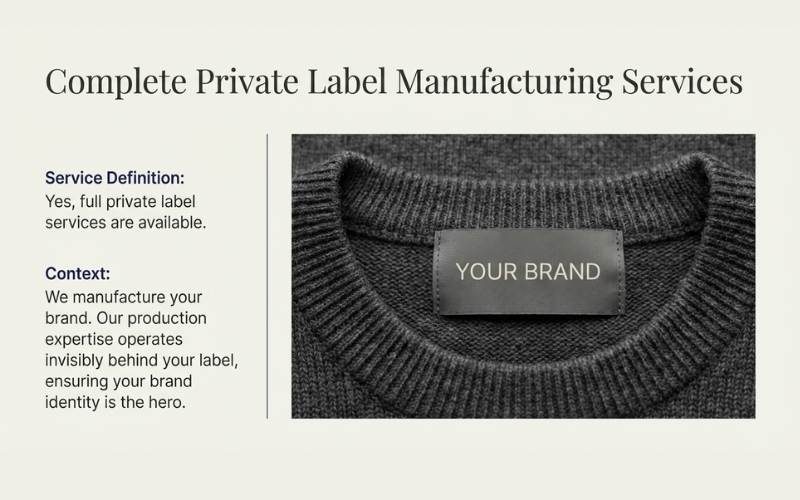
Private label clothing manufacturing enables fashion brands to launch collections under their own brand identity without operating their own production facilities.
With a monthly production capacity of approximately 200,000–250,000 units, Taşkın Moda can support both collection-based projects and repeat production programs for international fashion brands.
Production capacity becomes valuable only when it is supported by planning, quality control, supply chain coordination and repeatable manufacturing standards.
Complete Apparel Manufacturing Process in Turkey
A professional clothing manufacturer should manage apparel production as a complete workflow, not as a single sewing operation. The process begins with product evaluation and continues through sampling, bulk production, finishing and export preparation.
| Production Stage | Function |
| Project review | Evaluates product category, target market and buyer expectations |
| Fabric sourcing | Selects suitable materials for design, price and performance |
| Pattern making | Creates the technical structure of the garment |
| Sample development | Validates fit, construction and fabric behavior |
| Cutting and sewing | Executes approved production standards |
| Quality control | Checks consistency before shipment |
| Ironing and packaging | Prepares garments for commercial delivery |
| Shipment preparation | Organizes export-ready order handling |
This structured production flow helps buyers reduce sourcing risk and improve communication throughout the apparel manufacturing process.
OEM apparel manufacturing transforms a buyer’s technical specifications into commercially scalable ready-to-wear garments through standardized production processes.
Product Categories Manufactured by Taşkın Moda
International fashion brands often prefer working with one production partner across multiple apparel categories. This reduces supplier management complexity and helps maintain consistent production standards.
- T-Shirt Manufacturer in Turkey
- Dress Manufacturer in Turkey
- Wholesale Knitwear Manufacturer in Turkey
- Underwear Manufacturers in Turkey
- Jacket Manufacturers in Turkey
- Men’s Sweatpants Manufacturer in Turkey
- Swimwear Manufacturer in Turkey
These categories allow buyers to source casualwear, knitwear, outerwear, underwear, swimwear, dresses and men’s apparel through a coordinated manufacturing structure.
Turkey has become one of the world’s leading apparel manufacturing hubs because it combines textile experience, flexible production capacity and export-oriented supply chain management.
Private Label Clothing Manufacturing in Turkey
Private label clothing manufacturing allows brands to produce garments under their own label without operating their own factory. This model is especially useful for fashion startups, e-commerce brands, retailers and companies expanding into new apparel categories.
Taşkın Moda supports private label apparel projects through product review, fabric sourcing, model development, sampling, bulk production, finishing, packaging and export preparation.
| Private Label Need | Manufacturing Support |
| Own brand collection | Brand-specific garment production |
| Flexible category launch | Multi-product manufacturing |
| Export-ready orders | Packaging and shipment preparation |
| Repeat production | Scalable manufacturing planning |
Brands that need a focused private label strategy can review Private Label Clothing Manufacturer Turkey.
Apparel Exporter Turkey: Manufacturing for International Buyers
Many global buyers do not only need a manufacturer; they need an export-ready apparel partner. This is especially important for brands importing garments from Turkey to the UK, Germany, the Netherlands, the USA and other international markets.
An export-oriented clothing manufacturer should understand product preparation, packaging expectations, shipment planning and international buyer communication.
An apparel exporter in Turkey connects garment production with international trade readiness by managing manufacturing, quality control, packaging and shipment preparation.
For export-focused sourcing, buyers can review Apparel Exporter Turkey.
Country-Specific Apparel Manufacturing Strategy
Different countries evaluate Turkish clothing manufacturers through different buying priorities. A strong manufacturer should understand these market-specific expectations instead of using the same production message for every buyer.
| Market | Main Buyer Priority |
| United Kingdom | Fast sampling, private label production and e-commerce collections |
| Germany | Quality consistency, technical documentation and reliable delivery |
| Netherlands | European distribution, logistics and supply chain visibility |
| USA | China+1 sourcing, supplier diversification and scalable production |
This is why Taşkın Moda’s global strategy is built around country-specific sourcing intent rather than generic apparel manufacturing claims.
Why UK Brands Source Clothing from Turkey
UK fashion brands often look for fast collection development, private label production and flexible manufacturing. Turkey is attractive because it can support quicker sampling cycles, repeat production and export-ready garment preparation.
British buyers that need Turkey-based production can evaluate Taşkın Moda as a clothing manufacturer for UK brands through its private label, ready-to-wear and apparel export capabilities.
Why German Brands Source Clothing from Turkey
German fashion companies usually focus on quality assurance, technical documentation, measurement consistency and reliable production planning. Turkey offers a strong manufacturing base for brands that need structured garment production and repeatable quality standards.
Taşkın Moda supports German buyers by combining technical production workflow with international export preparation.
Why Dutch Brands Source Clothing from Turkey
Dutch buyers often think beyond domestic sales and evaluate manufacturers through European distribution logic. Supply chain visibility, repeat order planning, packaging consistency and export coordination are important for companies serving multiple European markets.
Turkey can support Dutch brands with flexible production and export-ready apparel workflows from Istanbul.
Why USA Brands Source Clothing from Turkey
American fashion companies increasingly evaluate Turkey as part of broader sourcing diversification. For USA brands, Turkey can support private label production, scalable ready-to-wear manufacturing and China+1 supplier strategy.
This makes Turkey a valuable option for companies that want to reduce dependency on one sourcing region while building additional production capacity.
OEM Clothing Manufacturing in Turkey
OEM (Original Equipment Manufacturing) clothing production allows fashion brands to manufacture garments according to their own technical specifications, measurements, materials and branding requirements. Unlike standard ready-made production, OEM manufacturing is built around the buyer’s product documentation and technical expectations.
For international apparel brands, OEM manufacturing offers greater control over garment construction, quality standards and product differentiation. Every production stage follows the approved technical package to ensure repeatable manufacturing quality.
| OEM Manufacturing Feature | Business Advantage |
| Buyer-owned design | Complete product ownership |
| Technical specifications | Consistent production standards |
| Brand-controlled labeling | Stronger brand identity |
| Repeat production | Reliable collection continuity |
| Scalable manufacturing | Supports future business growth |
OEM apparel manufacturing enables brands to transform technical product concepts into commercially scalable ready-to-wear collections.
Why Turkey Has Become a Strategic Manufacturing Hub
Turkey has evolved beyond being only a textile-producing country. Today it represents an integrated apparel manufacturing ecosystem where fabric sourcing, product development, garment production and export coordination operate together.
This integrated structure allows international buyers to manage multiple production stages through one manufacturing partner instead of coordinating several independent suppliers.
| Manufacturing Capability | Strategic Value |
| Integrated textile ecosystem | Better production coordination |
| Experienced garment workforce | Higher manufacturing quality |
| Flexible production planning | Supports changing market demand |
| International export experience | Simplifies global sourcing |
| Multi-category production | Reduces supplier complexity |
Quality consistency in garment manufacturing is achieved through process control at every production stage rather than final inspection alone.
China+1 Strategy and Turkey’s Role in Global Apparel Manufacturing
Many international fashion companies are adopting the China+1 sourcing strategy to reduce dependency on a single manufacturing region. Instead of replacing one country completely, brands establish additional production partners capable of supporting long-term supply chain resilience.
Turkey has become one of the preferred countries within this strategy because it combines apparel manufacturing expertise, export infrastructure and flexible production capacity.
| China+1 Objective | Turkey’s Contribution |
| Supplier diversification | Alternative manufacturing capacity |
| Business continuity | Reliable production planning |
| Supply chain resilience | Reduced sourcing dependency |
| Scalable manufacturing | Supports brand expansion |
| International sourcing | Export-ready garment production |
The purpose of China+1 is not to replace China. It is to create a stronger, more resilient global manufacturing network.
The China+1 sourcing strategy helps international fashion brands reduce supply chain dependency by establishing additional manufacturing partners outside a single production region.
Sustainable Apparel Manufacturing in Turkey
Sustainability has become an important evaluation criterion for international apparel buyers. Modern clothing manufacturers are increasingly expected to demonstrate responsible sourcing practices, efficient production planning and long-term supply chain transparency.
Beyond environmental considerations, sustainability also includes stable supplier relationships, repeatable production quality and responsible manufacturing processes.
| Sustainability Area | Importance |
| Responsible sourcing | Supports long-term partnerships |
| Production efficiency | Reduces operational waste |
| Supply chain transparency | Improves buyer confidence |
| Quality consistency | Reduces product returns |
| Social compliance awareness | Supports international sourcing expectations |
Quality Control System in Ready-to-Wear Manufacturing
Quality control should be integrated throughout the manufacturing process rather than performed only before shipment. A structured quality management system helps maintain garment consistency across repeated production cycles.
| Inspection Stage | Main Purpose |
| Fabric inspection | Material verification |
| Pattern review | Technical accuracy |
| Cutting inspection | Dimensional consistency |
| Sewing inspection | Construction quality |
| Final inspection | Shipment approval |
Consistent quality is achieved through process control rather than final inspection alone.
Technical Documentation and Sampling Process
Technical documentation is one of the most valuable communication tools between international buyers and clothing manufacturers. A complete tech pack reduces production uncertainty while improving sample accuracy.
Professional sampling allows brands to validate garment construction, fit, measurements, materials and finishing before bulk production begins.
| Technical Document | Purpose |
| Measurement chart | Size consistency |
| Construction details | Production accuracy |
| Fabric specification | Material consistency |
| Packaging instructions | Export preparation |
| Brand requirements | Private label implementation |
How Global Fashion Brands Build Manufacturing Networks
One of the biggest misconceptions in apparel sourcing is assuming that one supplier should manufacture every product. In reality, global fashion companies build supplier networks based on product expertise, manufacturing capability and strategic importance.
| Product Category | Preferred Manufacturing Capability |
| Knitwear | Experienced knitwear production |
| Outerwear | Technical sewing expertise |
| Swimwear | Specialized fabric handling |
| Private Label Collections | Integrated production workflow |
| Seasonal Collections | Flexible production planning |
The world’s strongest fashion brands rarely depend on a single factory. They build specialized manufacturing networks designed around expertise, flexibility and long-term collaboration.
How to Choose the Right Clothing Manufacturer in Turkey
Selecting a clothing manufacturer is one of the most important sourcing decisions for any fashion brand. While production price is often considered first, experienced buyers evaluate manufacturers using technical, operational and strategic criteria that influence long-term business performance.
The right manufacturing partner should be capable of supporting product development, quality consistency, production scalability and international export requirements throughout the lifecycle of the brand.
| Evaluation Criteria | Questions Buyers Should Ask |
| Manufacturing Experience | Does the manufacturer have experience with your product category? |
| Production Capacity | Can future growth be supported without changing suppliers? |
| Private Label Capability | Can your own brand be manufactured professionally? |
| Quality Control | Is inspection integrated throughout production? |
| Export Experience | Can international shipments be managed efficiently? |
| Communication | Are projects managed transparently? |
The best clothing manufacturer is rarely the cheapest supplier. It is the partner capable of supporting your brand over multiple collections with consistent quality and reliable production.
Buyer Decision Matrix
International buyers generally compare manufacturers using several commercial and technical criteria before making a sourcing decision. A structured decision matrix reduces procurement risk and improves long-term supplier selection.
| Selection Criteria | Importance | Business Impact |
| Quality Consistency | ★★★★★ | Protects brand reputation |
| Production Capacity | ★★★★★ | Supports future growth |
| Communication | ★★★★★ | Reduces production errors |
| Private Label Experience | ★★★★☆ | Strengthens brand identity |
| Export Capability | ★★★★☆ | Improves delivery performance |
| Sampling Process | ★★★★☆ | Validates products before production |
| Price | ★★★☆☆ | Should be evaluated after technical suitability |
Total Cost of Ownership (TCO) Analysis
Production cost represents only one part of the total sourcing investment. Buyers should evaluate the complete cost of working with a manufacturing partner throughout the production lifecycle.
| Cost Component | Business Impact |
| Sampling Revisions | Development cost |
| Quality Problems | Customer returns |
| Production Delays | Lost sales opportunities |
| Supplier Changes | Higher onboarding cost |
| Communication Issues | Operational inefficiency |
| Inventory Problems | Working capital impact |
The lowest manufacturing price rarely produces the lowest total sourcing cost.
ROI Analysis of Working with a Professional Clothing Manufacturer
Return on investment should be measured by evaluating how a manufacturing partner contributes to business growth, operational stability and long-term production efficiency.
| ROI Driver | Value Created |
| Repeat Production | Lower sourcing complexity |
| Quality Consistency | Reduced customer complaints |
| Scalable Capacity | Supports business expansion |
| Private Label Manufacturing | Improves brand positioning |
| Reliable Export Planning | Better international operations |
Manufacturer Evaluation Checklist
- Experience in your apparel category
- Integrated production workflow
- Pattern development capability
- Sampling expertise
- Quality assurance system
- Scalable production capacity
- Private label manufacturing support
- Export-ready organization
- Transparent communication
- Long-term production planning
Selecting a clothing manufacturer should be based on production capability, quality systems, export experience and long-term partnership potential rather than manufacturing cost alone.
Common Mistakes When Choosing a Clothing Manufacturer
Many sourcing problems occur before production even begins. Brands sometimes choose manufacturers based only on price or production speed without evaluating technical capability and long-term partnership potential.
| Common Mistake | Possible Consequence |
| Choosing only by price | Quality inconsistency |
| Skipping sample validation | Bulk production problems |
| Ignoring production capacity | Growth limitations |
| Poor technical documentation | Manufacturing errors |
| Weak communication | Project delays |
Successful apparel sourcing begins with selecting the right manufacturing partner—not simply the lowest quotation.
Why International Brands Choose Taşkın Moda
Taşkın Moda combines ready-to-wear garment manufacturing with export-oriented project management for international apparel brands. Since 2016, the company has developed an integrated production structure covering design support, R&D, fabric sourcing, planning, pattern making, cutting, sewing, finishing, packaging and shipment preparation.
With a monthly production capacity of approximately 200,000–250,000 garments, Taşkın Moda supports fashion brands looking for long-term manufacturing partnerships instead of transactional production relationships.
Whether your company is launching a new apparel brand, expanding an existing collection or diversifying its sourcing strategy, Taşkın Moda provides an integrated manufacturing model designed for international fashion businesses.
A scalable apparel manufacturer enables brands to increase production volume without changing suppliers as demand grows.
Conclusion
Turkey has become one of the world’s leading apparel manufacturing hubs because it combines textile expertise, flexible production, export capability and an established garment ecosystem.
Choosing the right clothing manufacturer requires evaluating quality systems, production planning, scalability, technical communication and export readiness rather than manufacturing cost alone.
Taşkın Moda supports global fashion brands through private label clothing manufacturing, OEM apparel production, ready-to-wear garment manufacturing and international apparel export from Turkey.
If you are looking for a long-term manufacturing partner, visit Taşkın Moda or contact our export specialists through the Contact Page to discuss your production requirements and sourcing strategy.
Frequently Asked Questions
Why is Turkey one of the world’s leading clothing manufacturing countries?
Turkey combines a strong textile industry, experienced garment manufacturers, flexible production capacity and export-oriented infrastructure, making it one of the preferred sourcing destinations for international fashion brands.
What services does Taşkın Moda provide as a clothing manufacturer?
Taşkın Moda provides design support, fabric sourcing, pattern making, sampling, cutting, sewing, quality control, packaging and international apparel export for ready-to-wear fashion brands.
Can Taşkın Moda manufacture private label clothing collections?
Yes. Taşkın Moda supports private label apparel production for international brands by manufacturing garments under the buyer’s own brand identity and technical specifications.
Which apparel categories can be manufactured?
The company manufactures t-shirts, dresses, jackets, knitwear, swimwear, underwear, men’s sweatpants and other ready-to-wear apparel categories.
Why do global fashion brands work with Turkish clothing manufacturers?
Global brands choose Turkish clothing manufacturers because they offer flexible production, strong textile expertise, export readiness, private label manufacturing and long-term supply chain reliability.
What is OEM clothing manufacturing?
OEM clothing manufacturing allows brands to produce garments based on their own technical specifications, materials, measurements and branding while the manufacturer manages the production process.
What is the difference between OEM and private label manufacturing?
OEM manufacturing follows the buyer’s detailed product specifications, while private label production focuses on manufacturing garments under the buyer’s own brand with agreed production standards.
How does Taşkın Moda support international apparel export?
Taşkın Moda integrates production with export planning by preparing garments for international shipment through quality control, packaging and coordinated export processes.
Can Taşkın Moda support growing fashion brands?
Yes. With a monthly production capacity of approximately 200,000–250,000 garments, Taşkın Moda supports both emerging brands and established international fashion companies.
How can I start working with Taşkın Moda?
You can contact Taşkın Moda through the Contact page to discuss your apparel category, production requirements, estimated order volume and export expectations with the company’s manufacturing specialists.