Clothing Manufacturer in Turkey
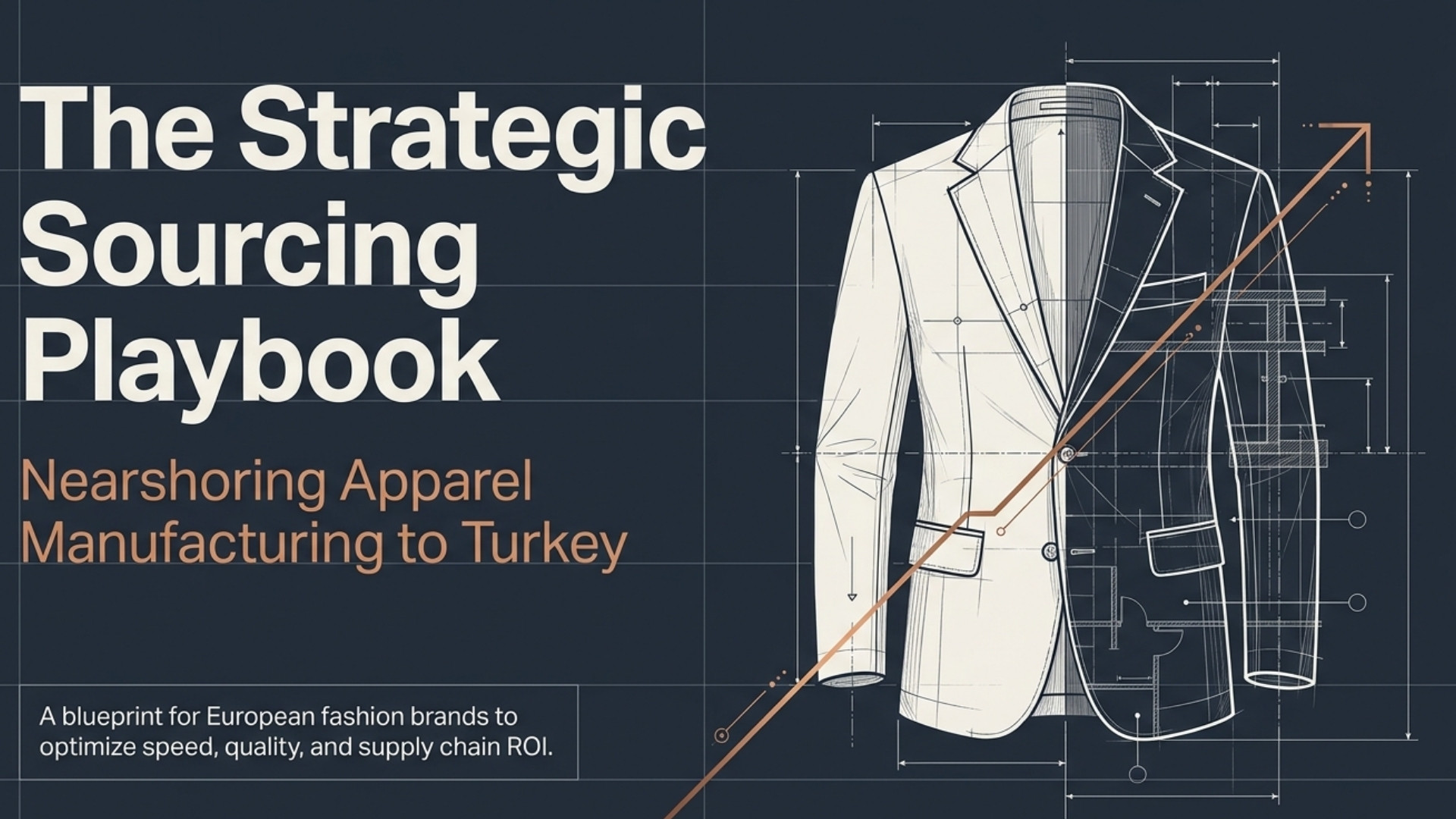
A clothing manufacturer in Turkey provides end-to-end apparel production services for fashion brands, including womenswear, menswear, and kidswear collections. These manufacturers support private label, OEM, and custom clothing production with integrated processes such as fabric sourcing, pattern making, sampling, mass production, and quality control. The main advantages include shorter lead times, flexible production capacity, and proximity to the European market. However, selecting the wrong manufacturer can lead to inconsistent quality, delayed deliveries, and increased supply chain costs.
For European fashion brands, Turkey has become a strategic sourcing hub due to its combination of industrial textile infrastructure, experienced production workforce, and efficient logistics access to EU markets. In modern apparel supply chains, production decisions are no longer based only on cost, but also on speed, reliability, and scalability.
A clothing manufacturer in Turkey is a production partner that manages the full lifecycle of apparel development, from design interpretation and sampling to bulk production and export logistics for global fashion brands.
Modern clothing manufacturing is not limited to sewing garments; it is an integrated system involving material selection, technical development, production planning, and quality assurance.
For European brands, the most critical selection factors for a manufacturing partner are lead time performance, quality consistency, communication efficiency, and production scalability.
Click here for information on wholesale swimwear production!
Click here for information on wholesale dress production!
Click here for information on wholesale T-shirt production!
Click here for information on wholesale underwear production!
Click here for information on wholesale jacket production!
Why European Brands Choose Clothing Manufacturers in Turkey
The global fashion industry has shifted from cost-only sourcing models to value-based supply chain strategies. European brands now prioritize speed-to-market, reduced inventory risk, and production flexibility when selecting manufacturing partners.
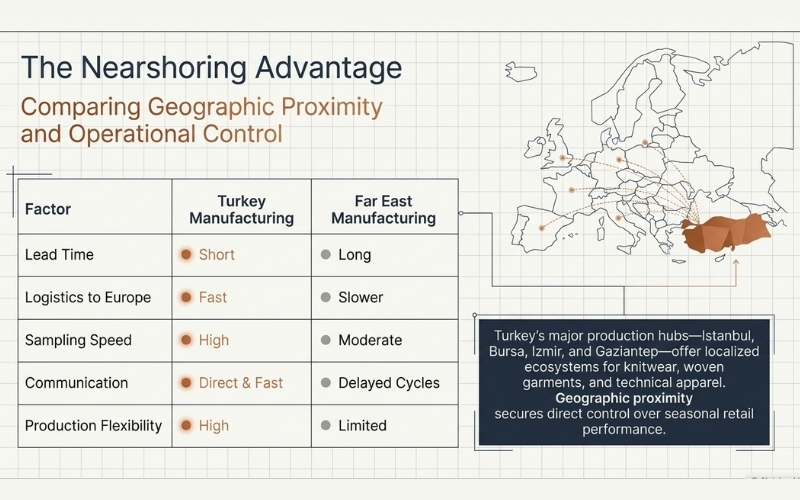
Turkey offers a unique advantage as a nearshore production hub for Europe. Its geographic proximity enables faster shipping times, easier communication cycles, and improved control over production timelines compared to traditional offshore manufacturing destinations.
This advantage is especially important for seasonal fashion collections, where delays in production directly impact retail performance and revenue cycles.
| Factor | Turkey Manufacturing | Far East Manufacturing |
| Lead Time | Short | Long |
| Logistics to Europe | Fast | Slower |
| Sampling Speed | High | Moderate |
| Communication Efficiency | Direct & Fast | Delayed Cycles |
| Production Flexibility | High | Limited |
Major production hubs such as Istanbul, Bursa, Izmir, and Gaziantep have developed strong ecosystems for knitwear, woven garments, and technical apparel manufacturing. This allows brands to access multiple production capabilities within a single sourcing region.
What Does a Clothing Manufacturer Actually Do?
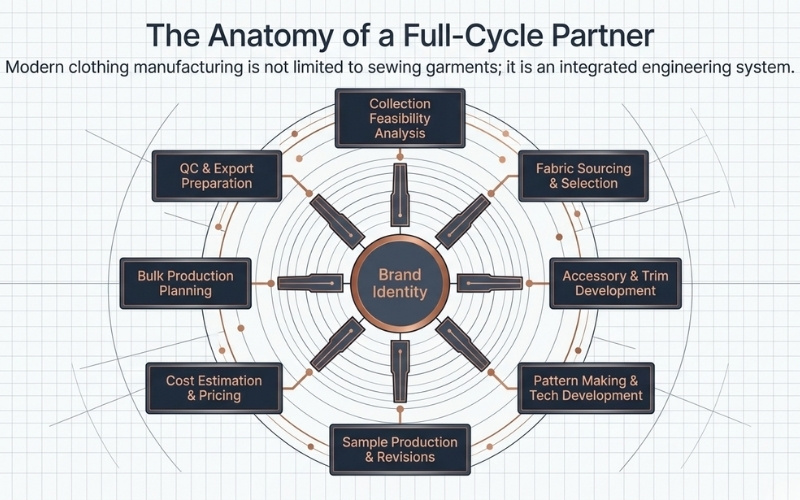
A professional clothing manufacturer operates as a full-cycle production partner rather than a simple sewing facility. The role extends across multiple stages of apparel development and supply chain execution.
When a fashion brand develops a new collection, the manufacturer typically manages the following processes:
- Collection feasibility analysis
- Fabric sourcing and selection
- Accessory and trim development
- Pattern making and technical development
- Sample production and revisions
- Cost estimation and pricing structure
- Bulk production planning
- Quality control inspections
- Packaging and export preparation
This structure allows brands to operate without maintaining in-house production departments while still maintaining full control over product quality and design direction.
Successful apparel manufacturing requires the integration of technical development, production engineering, and quality assurance into a single coordinated workflow.
Private label clothing manufacturing is a production model where garments are manufactured by a third party and sold under the brand’s own label.
Clothing Production Services at Taşkın Moda
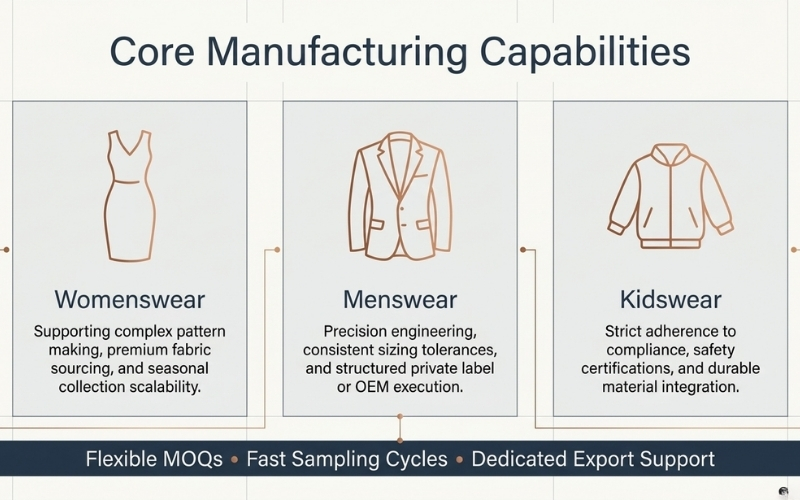
Taşkın Moda provides structured manufacturing solutions for womenswear, menswear, and kidswear categories. The production system is designed to support both emerging fashion startups and established European brands seeking scalable sourcing solutions.
Each project is handled through a structured workflow that includes fabric selection, sample development, production planning, and export coordination. This ensures consistency across different product categories while maintaining brand-specific requirements.
If you are developing a new fashion collection or expanding your existing product line, Taşkın Moda can provide technical consultation to evaluate production feasibility and optimize your manufacturing strategy.
How the Clothing Manufacturing Process Works
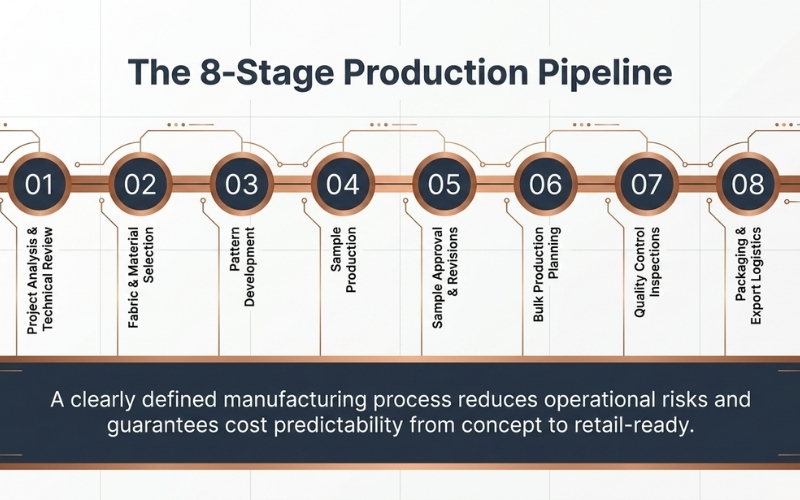
Transparency in production workflows is a critical requirement for European fashion brands. A clearly defined manufacturing process reduces operational risks and improves cost predictability.
| Stage | Description |
| 1 | Project analysis and technical review |
| 2 | Fabric and material selection |
| 3 | Pattern development |
| 4 | Sample production |
| 5 | Sample approval and revisions |
| 6 | Bulk production planning |
| 7 | Quality control inspections |
| 8 | Packaging and export logistics |
This structured workflow ensures that collections move from concept to retail-ready products in a controlled and predictable manner.
Manufacturer Selection by Brand Stage
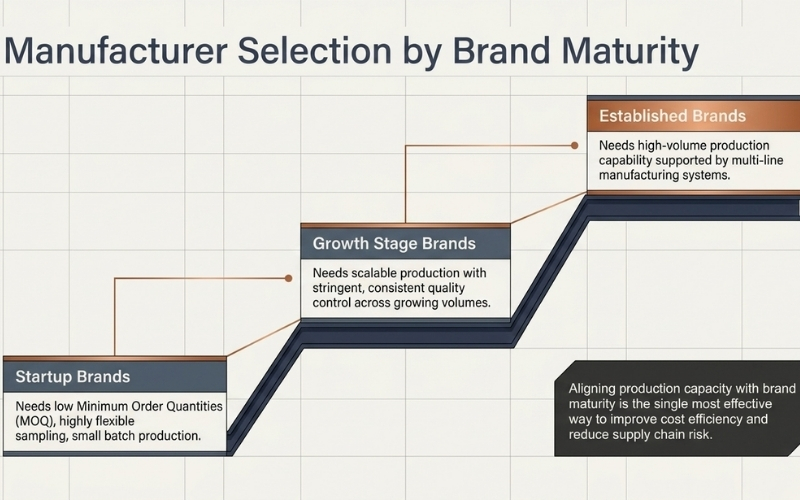
One of the most common mistakes in apparel sourcing is selecting a manufacturer that does not match the brand’s growth stage. Startup brands and enterprise-level fashion companies require fundamentally different production capabilities.
| Brand Stage | Recommended Manufacturing Model |
| Startup Brands | Low MOQ, flexible sampling, small batch production |
| Growth Stage Brands | Scalable production with consistent quality control |
| Established Brands | High-volume production with multi-line manufacturing systems |
Aligning production capacity with brand maturity improves cost efficiency and reduces operational risk across the supply chain.
Critical Supplier Selection Mistakes in Europe
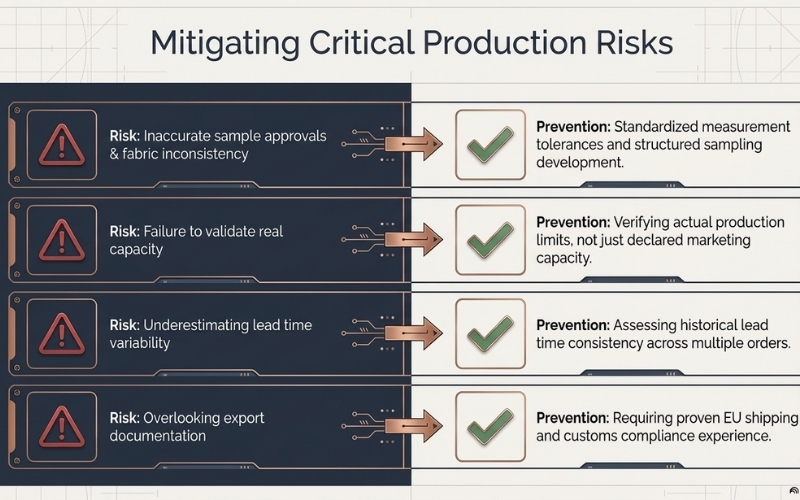
Many European fashion brands fail in supplier selection due to incomplete evaluation criteria. The most common overlooked factors include production verification, sampling accuracy, and export experience.
- Failure to validate real production capacity
- Ignoring sampling development quality
- Not assessing quality control systems
- Underestimating lead time variability
- Overlooking export documentation experience
These factors often have a greater impact on long-term performance than unit price differences in production quotations.
If you are evaluating a clothing manufacturer in Turkey for your next collection, Taşkın Moda can provide a structured technical assessment to determine production feasibility and optimize your sourcing strategy.
Clothing Manufacturing Models: OEM, ODM and Private Label Explained
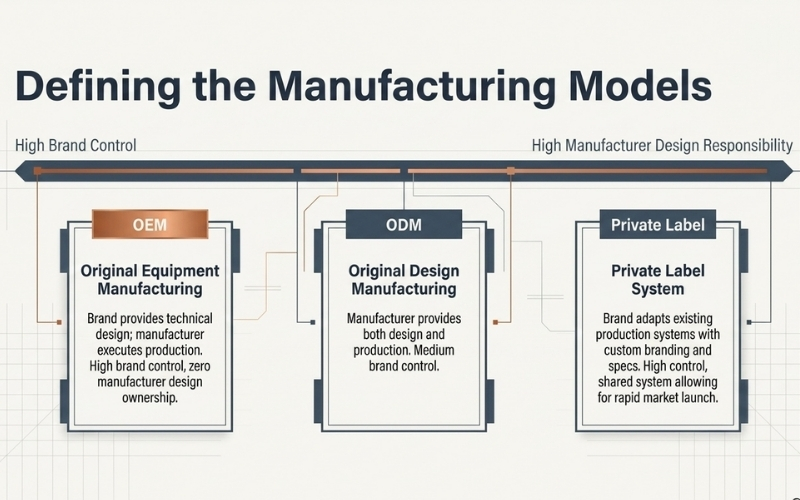
In the apparel industry, manufacturing models determine how much control a fashion brand has over design, production, and final product identity. Understanding the differences between OEM, ODM, and Private Label manufacturing is essential for selecting the right production strategy in Turkey.
| Model | Design Ownership | Manufacturer Role | Brand Control |
| OEM | Brand | Production Only | High |
| ODM | Manufacturer | Design + Production | Medium |
| Private Label | Shared / Adapted | Full Production System | High |
European fashion brands typically prefer OEM and Private Label models to maintain strong brand identity while outsourcing complex production processes to experienced manufacturers in Turkey.
OEM manufacturing is a production model where the brand provides the technical design and the manufacturer is responsible only for production execution.
Private Label manufacturing allows brands to launch products faster by adapting existing production systems with custom branding and specifications.
OEM clothing manufacturing is a system where the brand provides technical specifications and the manufacturer executes production without design ownership.
Technical Manufacturing Parameters That Define Supplier Quality
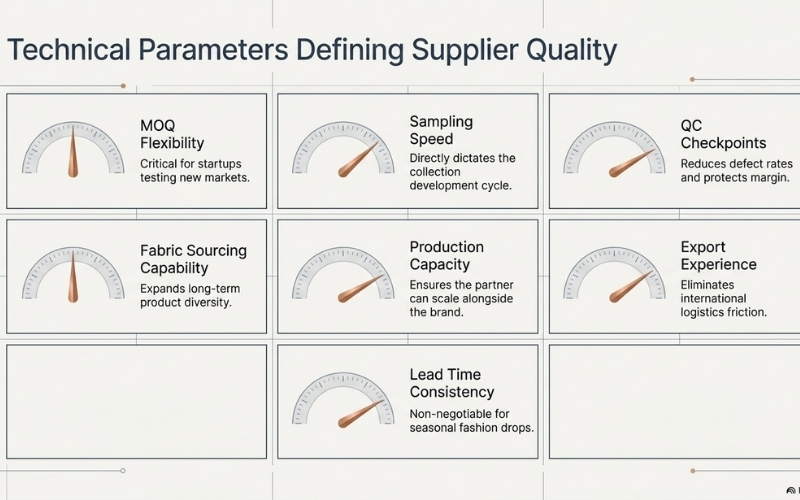
Choosing a clothing manufacturer in Turkey should not be based solely on pricing. Technical capabilities define long-term production reliability and scalability.
| Parameter | Importance |
| MOQ Flexibility | Critical for startups and small brands |
| Sampling Speed | Directly impacts collection development cycle |
| Quality Control System | Reduces defect and return rates |
| Fabric Sourcing Capability | Expands product diversity |
| Production Capacity | Enables brand scaling |
| Export Experience | Reduces international logistics risks |
| Lead Time Consistency | Critical for seasonal fashion brands |
| Certification Compliance | Required for European markets |
Certifications such as OEKO-TEX and GOTS are increasingly required by European buyers, especially in sustainable and ethical fashion segments.
Decision Matrix: How to Select the Right Clothing Manufacturer
A structured decision matrix helps fashion brands evaluate manufacturers beyond price comparisons. This approach reduces sourcing risks and improves long-term supply chain stability.
| Criteria | Weight | Impact Level |
| Product Quality | 25% | Very High |
| Delivery Performance | 20% | Very High |
| Communication Efficiency | 15% | High |
| Pricing Structure | 15% | High |
| Production Flexibility | 10% | High |
| Sampling Capability | 10% | High |
| Certification & Compliance | 5% | Medium |
This model is widely used by European sourcing teams to evaluate apparel suppliers in nearshore production regions such as Turkey.
ROI Analysis: Real Value of Manufacturing in Turkey
The real return on investment in clothing manufacturing is not determined only by unit cost. Operational efficiency, lead time reduction, and defect rates significantly influence total profitability.
Manufacturing in Turkey allows European brands to reduce time-to-market, which directly improves seasonal sales performance and inventory turnover rates.
| Factor | ROI Impact |
| Short Lead Times | Positive |
| Low Sampling Delays | Positive |
| Efficient Communication | Positive |
| Geographic Proximity to EU | Positive |
| Reduced Inventory Risk | Positive |
In apparel sourcing, the highest ROI is achieved through faster product cycles, reduced operational friction, and improved supply chain visibility rather than lowest unit cost.
TCO Analysis: Total Cost of Ownership in Apparel Production
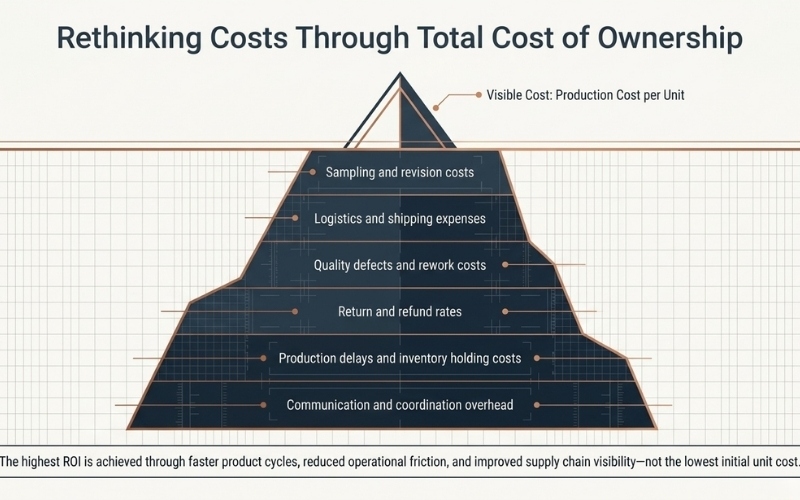
Total Cost of Ownership (TCO) provides a more accurate financial model than unit pricing when evaluating clothing manufacturers.
TCO includes all direct and indirect costs associated with apparel production:
- Production cost per unit
- Sampling and revision costs
- Logistics and shipping expenses
- Quality defects and rework costs
- Return and refund rates
- Production delays
- Inventory holding costs
- Communication and coordination overhead
Many low-cost suppliers appear cheaper initially but result in higher TCO due to inefficiencies and quality inconsistencies.
Lead time in apparel manufacturing refers to the total duration between sample approval and final product delivery to the buyer.
Engineering Approach to Clothing Manufacturing
Modern apparel manufacturing requires an engineering-based approach where production processes are standardized, measurable, and continuously optimized.
This includes production line balancing, workflow optimization, quality assurance systems, and material efficiency planning.
A stable clothing manufacturing system is achieved not through individual craftsmanship alone, but through standardized and repeatable production engineering processes.
Common Production Risks in Apparel Manufacturing
Many fashion brands switch suppliers due to recurring production issues that could be prevented with proper planning and evaluation.
- Inaccurate sample approvals
- Fabric inconsistency between batches
- Undefined measurement tolerances
- Weak quality control checkpoints
- Unrealistic delivery timelines
- Missing technical specification sheets
- Poor communication structure
Addressing these risks early significantly improves production reliability and reduces long-term sourcing costs.
Why Nearshoring Matters for European Brands
Nearshoring refers to sourcing production closer to the target market. For European fashion brands, Turkey has become a strategic nearshore manufacturing hub.
Compared to distant sourcing regions, Turkey offers faster sampling cycles, shorter shipping times, and improved supply chain visibility.
| Factor | Nearshoring Advantage |
| Sampling Speed | Faster |
| Delivery Time | Shorter |
| Communication | More Efficient |
| Quality Control | More Transparent |
| Market Responsiveness | Higher |
For brands producing womenswear, menswear, and kidswear collections, nearshore manufacturing in Turkey provides a balanced solution between cost efficiency and operational control.
If you are evaluating a clothing manufacturer in Turkey, Taşkın Moda offers structured production assessment, sampling development, and full-cycle apparel manufacturing support tailored to European fashion brands.
Nearshoring in fashion refers to sourcing production in geographically closer countries to reduce logistics time and improve supply chain control.
Buying Guide: How to Choose a Clothing Manufacturer in Turkey
Selecting a clothing manufacturer in Turkey requires a structured evaluation approach that goes beyond pricing. European fashion brands should assess technical capability, production stability, communication quality, and export readiness before making a sourcing decision.
A reliable manufacturing partner should demonstrate proven experience in womenswear, menswear, and kidswear production, along with consistent sampling quality and scalable production systems.
- Evaluate real production capacity, not only declared capacity
- Request sample development before bulk orders
- Verify quality control processes at every production stage
- Assess lead time consistency across multiple orders
- Check export documentation and EU shipping experience
Brands that apply structured supplier evaluation methods significantly reduce production risks and improve long-term profitability.
Sustainability in Clothing Manufacturing
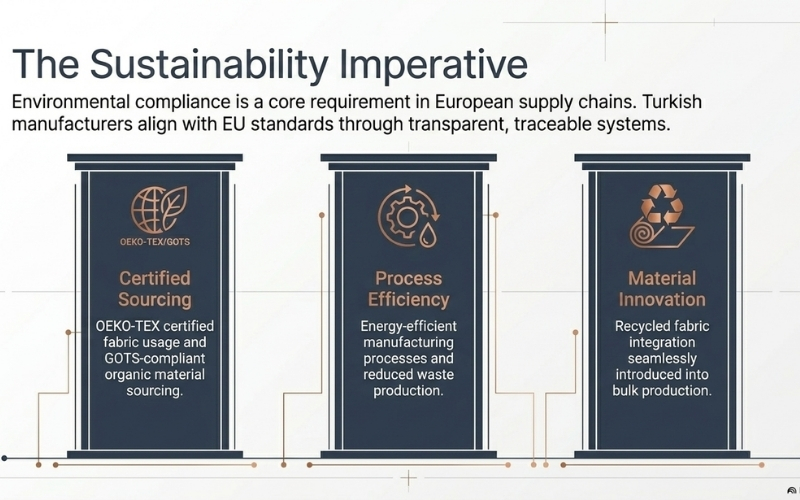
Sustainability has become a core requirement in European fashion supply chains. Clothing manufacturers in Turkey increasingly adopt environmentally responsible production methods to meet EU compliance standards.
Key sustainability practices include responsible fabric sourcing, reduced waste production, and compliance with international certifications such as OEKO-TEX and GOTS.
Sustainable clothing manufacturing refers to production systems that minimize environmental impact while maintaining consistent quality and ethical labor standards across the supply chain.
- OEKO-TEX certified fabric usage
- GOTS compliant organic material sourcing
- Recycled fabric integration in production
- Energy-efficient manufacturing processes
- Transparent and traceable supply chains
Strong global textile certification entity
Conclusion: Why Turkey is a Strategic Clothing Manufacturing Hub
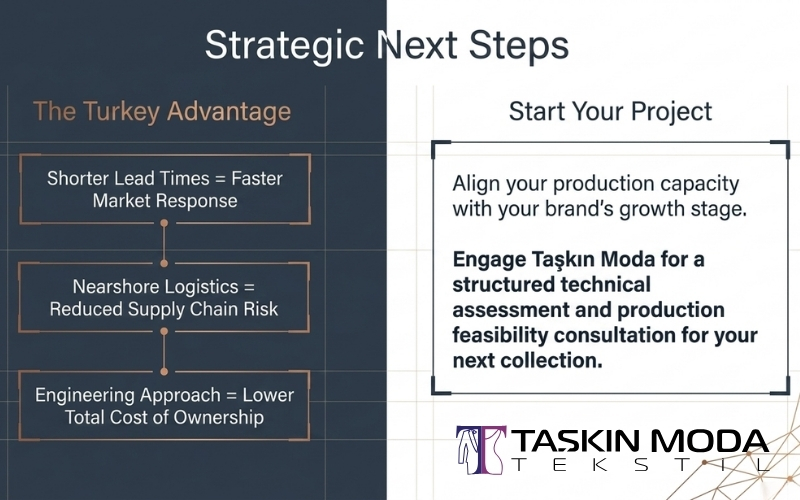
Turkey has positioned itself as one of the most important apparel production hubs for European fashion brands. The combination of nearshore logistics advantages, flexible production capacity, and experienced textile infrastructure makes it a competitive alternative to distant sourcing regions.
For brands producing womenswear, menswear, and kidswear collections, Turkey offers a balanced model between cost efficiency, speed, and quality control.
Choosing the right manufacturing partner directly impacts brand scalability, product consistency, and overall supply chain performance.
If you are looking for a reliable clothing manufacturer in Turkey, Taşkın Moda provides end-to-end production solutions tailored to European fashion brands, including sampling, private label production, OEM manufacturing, and export support. Contact us!
FAQ: Clothing Manufacturer in Turkey
What is a clothing manufacturer in Turkey?
A clothing manufacturer in Turkey is a production partner that handles design development, sampling, bulk production, quality control, and export logistics for fashion brands.
Why do European brands choose clothing manufacturers in Turkey?
European brands choose Turkey due to shorter lead times, nearshore logistics advantages, flexible production capacity, and strong textile infrastructure.
What types of clothing can be produced in Turkey?
Manufacturers in Turkey produce womenswear, menswear, kidswear, sportswear, and private label fashion collections.
What is private label clothing manufacturing?
Private label manufacturing allows brands to sell products under their own label using manufacturer-managed production systems.
What is the difference between OEM and private label?
OEM manufacturing follows brand-provided designs, while private label production adapts existing manufacturing systems for branded collections.
Is low MOQ clothing production possible in Turkey?
Yes, many Turkish manufacturers offer flexible MOQ options depending on product type and production complexity.
How long does clothing production take in Turkey?
Lead times vary, but Turkey generally offers faster sampling and production cycles compared to distant sourcing regions.
What certifications are important for clothing manufacturing?
OEKO-TEX and GOTS certifications are widely recognized for quality and sustainability compliance in European markets.
What is nearshoring in fashion manufacturing?
Nearshoring refers to sourcing production closer to the target market to reduce lead times, logistics complexity, and supply chain risks.
Does Taşkın Moda produce womenswear, menswear, and kidswear?
Yes, Taşkın Moda provides structured manufacturing solutions across womenswear, menswear, and kidswear categories for international fashion brands.