Differences Between Ready-to-Wear and Fast Fashion

Ready-to-wear is a mass production model based on standardized sizing systems, planned according to seasonal collections, and optimized with structured quality control processes. Fast fashion, on the other hand, is a rapid production system that analyzes trend data in real time and delivers low-cost collections within very short timeframes.
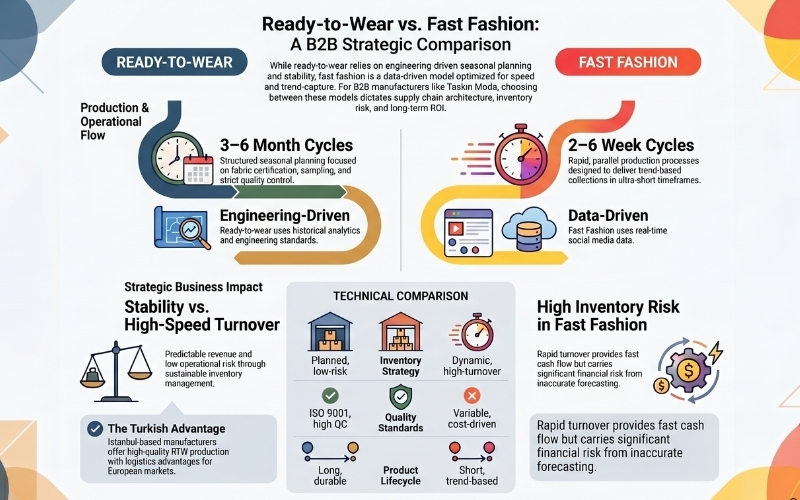
For B2B textile manufacturers like Taşkın Moda, the difference between these two models goes beyond design. It directly impacts supply chain architecture, inventory management, production speed, and profitability models, making it a critical strategic distinction.
While ready-to-wear focuses on long-term planning and quality control, fast fashion is built on short-term trend capture and rapid sales cycles.
What Are Ready-to-Wear and Fast Fashion?
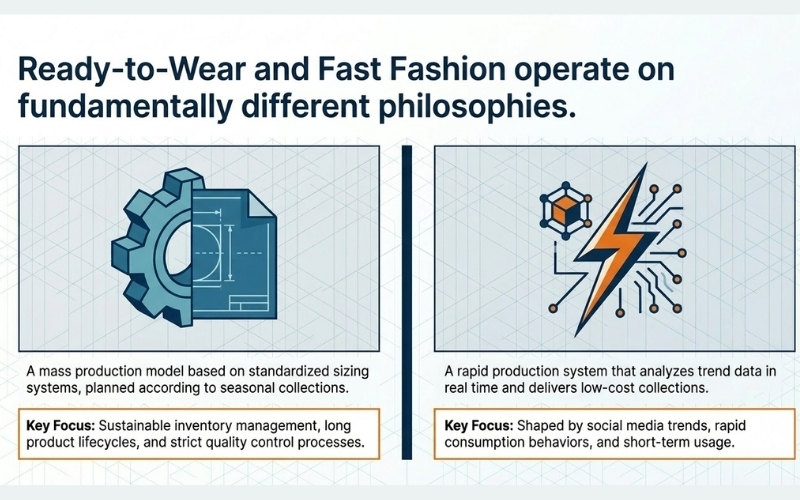
Ready-to-wear is a textile production model based on structured collection planning, where every stage—from fabric selection to quality control—is carefully managed. The goal is sustainable inventory management and long product lifecycle.
Fast fashion is shaped by social media trends, influencer insights, and rapid consumption behaviors. Products are designed for short-term usage and fast turnover.
Production Process and Supply Chain Differences
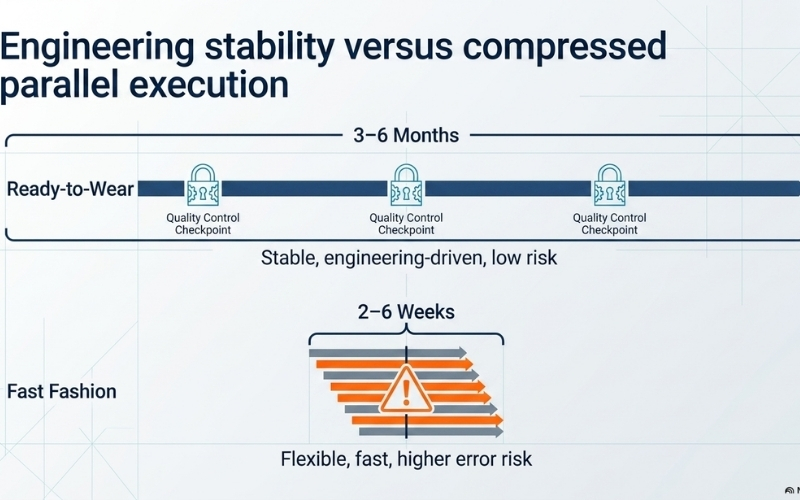
Ready-to-wear production is typically more stable and engineering-driven. Production cycles are divided into seasons, and each stage passes through strict quality control checkpoints. In contrast, fast fashion compresses processes and runs them in parallel, increasing speed but also raising the risk of errors.
| Production Model | Production Time | Inventory Strategy | Quality Standards | Supply Chain Structure | Product Lifecycle | Profitability & Risk |
| Ready-to-Wear | 3–6 months (seasonal planning) | Planned inventory, low-risk sustainable processes | ISO 9001-based systems, certified materials, high QC | Long-term, stable, engineering-driven | Long lifecycle, durable products | Stable revenue, high ROI; slower adaptation to trends |
| Fast Fashion | 2–6 weeks (rapid production) | Dynamic inventory, high turnover, high risk | Variable quality, cost-driven material selection | Flexible, fast, parallel processes | Short lifecycle, trend-based products | Fast cash flow but high stock risk and TCO |
Technical Production and Collection Planning Model
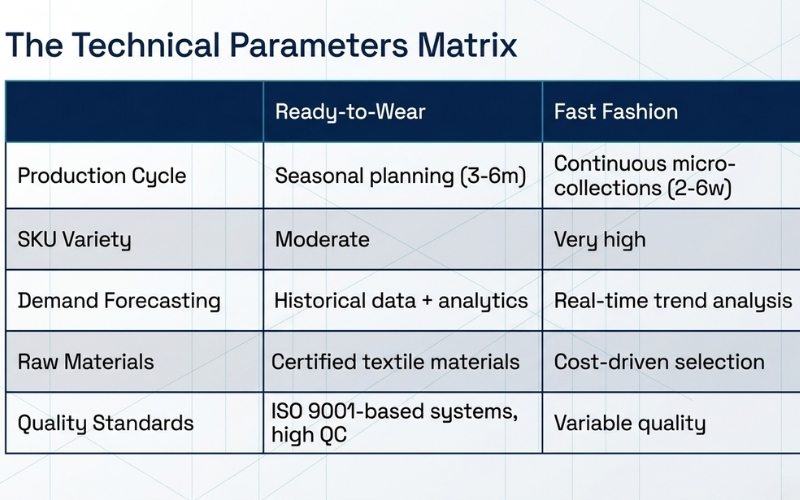
In ready-to-wear, collection planning is a critical engineering process. Fabric selection, pattern development, and sampling follow strict standards.
In fast fashion, production is data-driven. Sales trends, social media engagement, and regional demand directly influence production decisions.
| Technical Parameter | Ready-to-Wear | Fast Fashion |
|---|---|---|
| Production Cycle | Seasonal planning | Continuous micro-collections |
| SKU Variety | Moderate | Very high |
| Demand Forecasting | Historical data + analytics | Real-time trend analysis |
| Raw Materials | Certified textile materials | Cost-driven selection |
B2B Purchasing Guide and Business Model Analysis
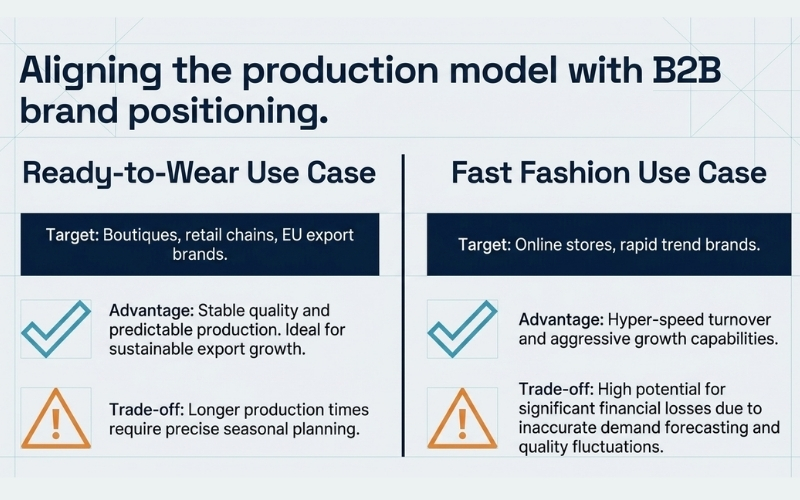
For B2B buyers, choosing between ready-to-wear and fast fashion is not just a sourcing decision—it directly impacts ROI (Return on Investment), TCO (Total Cost of Ownership), inventory efficiency, production capacity, and supply chain performance.
Ready-to-wear offers structured production cycles, lower operational risk, and long-term inventory stability. Companies that optimize the ready-to-wear production process achieve more sustainable export growth.
Fast fashion enables rapid trend adaptation and fast turnover. However, fast fashion inventory risk can lead to significant financial losses due to inaccurate demand forecasting.
Success in B2B fashion depends not only on production speed but also on supply chain optimization, inventory management, and demand forecasting accuracy.
| Production Model | Production Cycle | Inventory Strategy | Quality Standards | Supply Chain Structure | Product Lifecycle | Primary Risks | Ideal Use Case |
| Ready-to-Wear | 3–6 months | Planned inventory with stable management; focuses on low-risk sustainable processes | High quality control (QC) via ISO 9001-based systems; uses certified materials and strict checkpoints | Long-term, stable, and engineering-driven; utilizes structured production systems | Long-term lifecycle with durable products | Slower adaptation to market trends and longer production lead times | Boutiques and retail chains; companies seeking sustainable export growth and EU export |
| Fast Fashion | 2–6 weeks | Dynamic inventory with high turnover; focuses on fast cash flow and high-risk strategies | Variable quality based on cost-driven material selection; risk of errors due to parallel processes | Flexible and fast; data-driven and trend-capture focused using parallel processes | Short lifecycle; trend-based products designed for short-term usage | High stock risk; Total Cost of Ownership (TCO) risk; quality fluctuation; financial losses from inaccurate forecasting | Online stores and trend brands requiring rapid trend adaptation and fast turnover
|
Turkey-based manufacturers, especially in Istanbul, offer strong export advantages for ready-to-wear production due to proximity to European markets. Fast fashion provides aggressive growth but requires precise inventory and demand management.
Therefore, B2B buyers should evaluate suppliers not only by price but by production capacity, supply chain optimization, inventory control, and sustainability capabilities.
Professional Industry Analysis in Ready-to-Wear and Fast Fashion
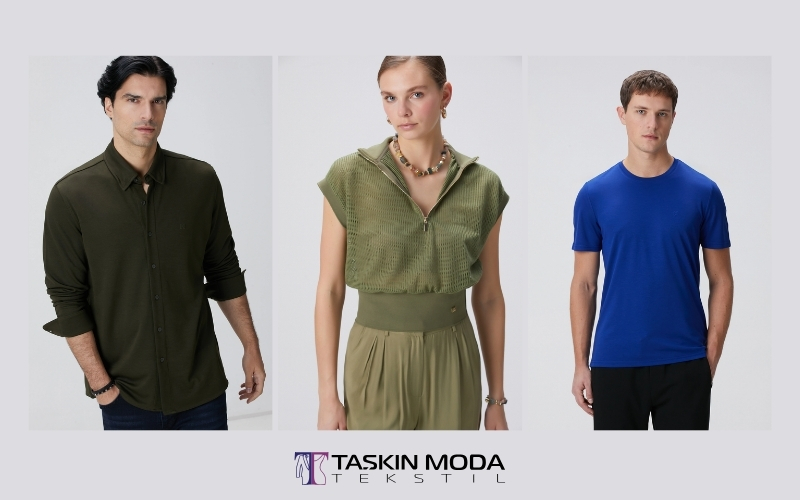
Turkey’s textile industry has strong export capabilities, particularly in ready-to-wear production for European markets. Istanbul-based manufacturers benefit from fast logistics and strong quality control systems.
Although fast fashion is more dominant in Asia, Turkish manufacturers are increasingly adapting to rapid production models. However, inventory management and production planning accuracy remain the most critical factors.
In this competitive landscape, choosing the right supplier is essential. Taşkın Moda provides B2B brands with scalable production planning, controlled inventory management, and EU-compliant collections.
Taşkın Moda Quality in the Ready-to-Wear Industry
Ready-to-wear and fast fashion differ not only in production speed but also in business model, supply chain strategy, brand positioning, and financial risk management.
Taşkın Moda offers a sustainable B2B business model through structured production systems, controlled supply chain management, and scalable collection development. Businesses looking to optimize product development, collection planning, and wholesale sourcing strategies can benefit from project-based evaluations.
For detailed information and tailored production solutions, companies can contact Taşkın Moda to request a customized quotation and supply plan.
Frequently Asked Questions
What is ready-to-wear?
Seasonally planned, standardized mass-produced clothing.
What is fast fashion?
A model focused on rapid trend-based production and short product cycles.
Which is more profitable?
Ready-to-wear offers stable income; fast fashion offers speed but higher risk.
Which model is Turkey strong in?
Turkey is highly competitive in ready-to-wear production and export.

Özlem Kılıç

LinkedIn Profili →